
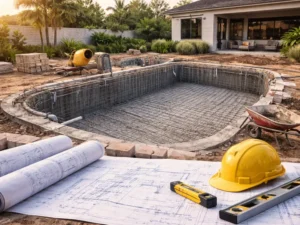
You can usually build a pool close to your house, a retaining wall or a sewer line, but the closer it gets, the more the engineering has to account for. Nearby footings can load the pool, digging the pool can undermine them, and sewer lines can need a separate approval before you build. If your pool builder or certifier has flagged something as too close, this is what the engineering has to resolve.
Request a quote
Ardent has engineered 80+ concrete pools in the last 12 months. This guide explains the zone of influence, building near or over sewer lines, boundaries and fences, and what to send your engineer.
The zone of influence
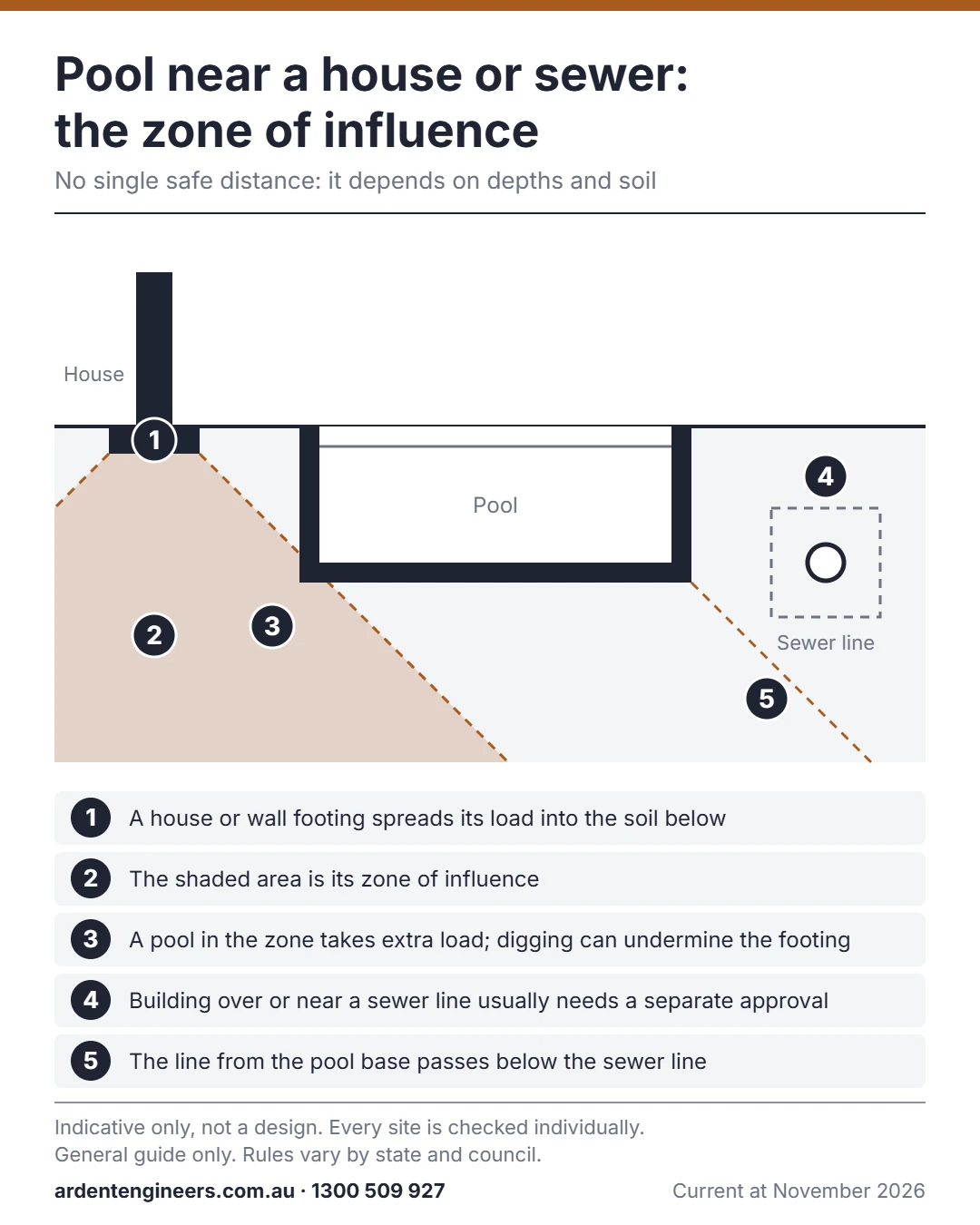
Every footing spreads its load into the soil below and around it. That area is called the zone of influence.
If your pool sits inside the zone of influence of a house, a retaining wall or another structure, two things matter:
- Load on the pool. The nearby footing pushes on the soil next to the pool, adding pressure to the pool wall. The design has to carry it.
- Undermining. Digging the pool can remove soil that supports the nearby footing. Unless it’s designed for, that can cause movement or cracking in the house or wall.
How close is too close depends on the depth of the pool, the depth of the nearby footings and your soil. There’s no single distance that suits every site, so we check it for yours.
What the engineer can do about it
When a structure is in the zone of influence, the usual options are:
- Design the pool wall for the extra load (surcharge) from the nearby footing.
- Underpin or deepen the nearby footing, or support the pool on piers that reach below the zone.
- Set the dig out safely with a batter or an excavation method shown on the drawings, so the builder doesn’t undermine the footing during construction.
- Move the pool a little, if that’s simpler than the alternatives.
We pick the option that’s simplest to build and sized for your site, so you don’t pay for structure you don’t need. Where we can’t confirm the depth of a nearby footing from plans, photos or a survey, we’ll state the assumed depth on the drawings, to be confirmed on site, and design for the worst case.
Pools next to retaining walls
A pool beside an existing retaining wall is a common case on sloping blocks. The wall may be loading the pool, or the pool may be loading the wall. Either way, the two need to be checked together. A recent example in The Gap, Queensland: a 5 × 3 m concrete pool on a slope, 1.2 m out of the ground at the deep end, designed with a 1.2 m retaining wall to the side boundary.
If you’re building a new wall at the same time, we can design the pool and the wall together so they support each other. See building a pool on a sloping block and retaining wall engineering. If the old wall is being replaced, the replacement needs the same design, certification and approval as a new wall.
Inspections, dilapidation reports and failure investigations: South East Queensland only.
Sewer and stormwater lines
Many backyards have a sewer or stormwater line running through them, often near the back boundary. Building a pool over or close to one usually needs approval from the water authority or council, and the pool has to be designed so it doesn’t load or damage the pipe.
What this means for your project:
- We check services early. A services search (Before You Dig) shows where sewer, stormwater and water lines run. Your proposal will say whether it’s included.
- The drawings show them. Services near the pool are shown with their offsets, and any sewer clearance zone is dimensioned.
- Build-over or near-sewer approval may be needed before construction, and can add time. The rules and clearances vary by authority, so check early. See building over or near a sewer.
- Sometimes the pool moves. Shifting the pool clear of the line can be cheaper and faster than designing over it.
Boundaries and fences
Pools near a boundary bring a few extra checks:
- Setbacks from the boundary, set by your council.
- Neighbouring footings and walls, which may be in the zone of influence.
- Pool fencing must meet the barrier rules. If a fence sits on top of a retaining wall or pool wall, that wall carries extra load from the fence.
- Approval content: your certifier or council may want the pool fence on the site plan or boundary elevations. We can quote these as options.
How this affects cost and time
Structural engineering for a standard residential concrete pool starts from $900 + GST, including your certificate. Items that add design work, such as piers, a fence on an adjoining wall, out-of-ground sections or underpinning, are quoted separately so you only pay for what your site needs. Hydraulic design, an NCC requirement, is quoted with your pool.
Design and certification takes 10 business days from acceptance, and fast-track documentation is available. Every design is independently reviewed by a second engineer and signed off by our Director. A build-over or near-sewer approval, and council approval, come on top: approval time is up to your council and certifier, and can take 2–6 weeks.
What to send
- Site address, and a site plan showing where the pool goes.
- Distances from the pool to the house, boundaries, fences and any retaining walls.
- Sewer and stormwater lines near the pool, if known.
- Plans of the house or wall, if you have them, so we can see footing depths.
- Pool shape, size and depths.
- Site levels or a survey on sloping blocks.
- Photos of the area, including the nearby walls and the house.
- A soil or geotechnical report, if you have one.
No plans yet? Rough measurements, a sketch and a few photos are enough for a first quote. Request a quote or call 1300 509 927: a team leader scopes your pool, and you get a fixed-price proposal that lists what’s included.
Common questions
How close can a pool be to my house?
It depends on the pool depth, your house footings and your soil, so there’s no single distance. If the pool is inside the house footings’ zone of influence, we design for it.
Can I build a pool over a sewer line?
Sometimes, with approval from the water authority or council and a design that protects the pipe. Moving the pool clear of the line is often simpler.
Will digging the pool damage my retaining wall?
It can if it isn’t designed for. We check the wall and the pool together and show a safe excavation method on the drawings.
Do you inspect existing walls near the pool?
Inspections, dilapidation reports and failure investigations are available in South East Queensland only. Elsewhere, where we rely on an existing wall or footing, we state our assumptions on the drawings, to be confirmed on site.
Get a fixed quote
From $900 + GST for a standard residential pool, including your certificate. Fixed quote, no hidden costs. 10 business days from acceptance; fast-track available.
Request a quote or call 1300 509 927.
Related: concrete pool engineering · Brisbane pool engineers